
Vinegar, CLR or a Water Spot Remover? What Actually Works on Car Glass
White vinegar can loosen fresh, light mineral haze on car glass, but it is not a reliable answer to every baked-on ring. CLR’s maker advises against using its Calcium, Lime and Rust Remover on cars except for rust on chrome or stainless-steel wheels; stubborn glass deposits call for a glass-specific method such as Spotless X2.
The short answer: pick by severity
| Situation | Start with | Reason |
|---|---|---|
| Fresh, light mineral haze | Optional diluted white vinegar, with a patch test | A mild acid can loosen some fresh mineral deposits. |
| Stubborn rings or vinegar failed | Spotless X2 | A dedicated polishing glass remover addresses stains and can remove etching on glass. |
| Tempted to use CLR | Choose a glass-specific product instead | The maker warns against car use and painted or coated surfaces. |
Begin with a normal wash and dry so loose dirt and cleaner streaks are not mistaken for permanent spots. Match the method to the actual surface. Automotive windows sit inside a system of paint, trim, seals and sometimes aftermarket films; a cleaner touching bare glass is only part of the compatibility question.
What vinegar actually does and does not do
White vinegar contains acetic acid, which can react with some mineral deposits. That makes it a fair optional first try for fresh, light haze on compatible bare glass. It does not mean a pantry cleaner has been validated for every automotive coating, film edge or surrounding trim material.
If one careful attempt leaves the same rings, do not keep increasing concentration, contact time or pressure. Baked-on deposits and surface damage are different from a light haze. Rinse and dry before judging the result; a wet windshield or a streaked one can make progress hard to assess.
Vinegar is inexpensive as a household item, but there is no verified per-car cost or performance score here. Light deposits may respond; persistent stains need a different approach, not harder rubbing.
Can you use CLR on car windows?
For CLR Calcium, Lime and Rust Remover, follow the maker’s warning rather than a generic online dilution recipe. The CLR automotive-use FAQ says it does not recommend car use and identifies rust on chrome or stainless-steel wheels, not alloys, as the exception. That exception is not permission to clean windshields with it.
The maker’s excluded-surfaces FAQ also lists painted, coated and sealed surfaces, plastics and aluminum among its keep-off materials. Maker guidance checked November 5, 2026 (HST). This discussion concerns that named product, not every product sold under the CLR brand.
What a dedicated glass remover is for

Spotless X2 is a polishing glass water spot remover with diamond micro-particles. It removes hard water stains and can remove etching on glass. That is a different mechanism from simply applying a pantry acid. It does not guarantee that every deep defect can be restored or that longer, harder scrubbing improves a result.
Harder stains can take 2–3 passes. A little damp is preferred, although it can be used dry; there is no sit or dwell step. A 16 oz bottle covers 1–2 cars or several shower doors. It has 1,240 reviews. Those figures describe the product, not a controlled comparison against vinegar or CLR.
Use Spotless X2 on the untinted side only. Keep it off paint and natural stone. It takes off factory easy-clean coating, so check the instructions for any factory or aftermarket rain-repellent treatment you want to retain. Do not assume the word “glass” makes every coating on the glass expendable.
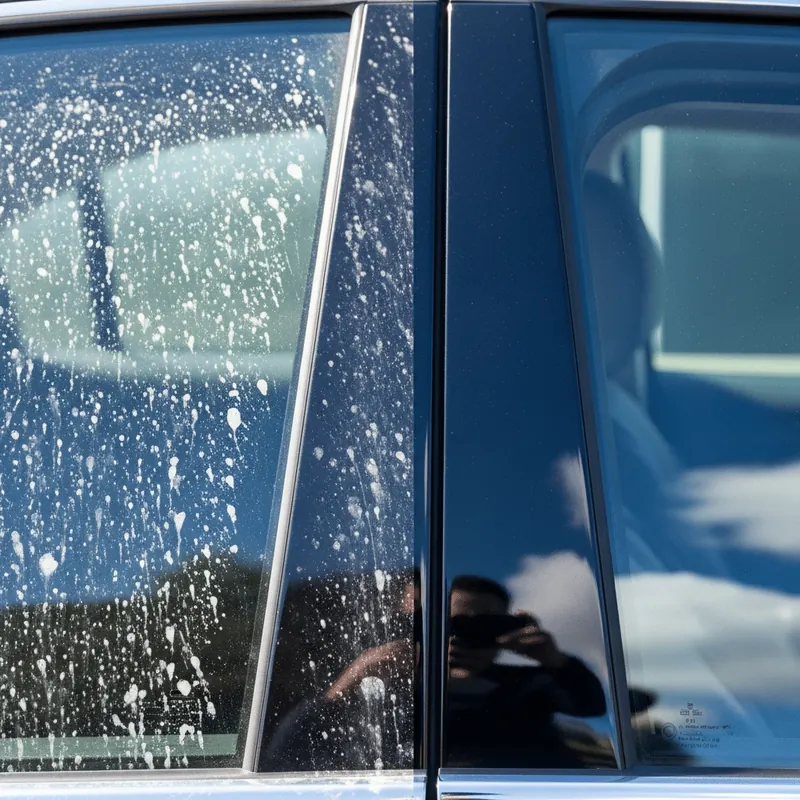
Deposit vs etching on car glass
Deposits remain on top of the surface; etching is damage into it. A raised ring suggests buildup, while a cloudy or frosted area after cleaning can indicate damage, but appearance alone is not conclusive. Compare the same clean, dry test patch under the same light and see the deposits vs etching explainer.
Spotless X2 can address etching on glass, so “etched” is not automatically a reason to abandon a careful test. It is also not permission to chase every persistent mark indefinitely. Stop aggressive scrubbing that adds haze, and seek an assessment if the test does not improve or you cannot identify the defect.
Step-by-step: one optional vinegar try, then Spotless
Optional vinegar first pass
For fresh haze only, check glass, coating and film care instructions first. Patch-test diluted white vinegar on compatible glass, keep liquid off film edges and surrounding materials, then rinse and dry. This is an optional low-severity test, not a vinegar treatment recipe for paint. If compatibility is uncertain, skip it.
Spotless X2 method
Read the current how-to-use guide and the label first, and work on cool glass. Put a quarter-sized dab on a microfiber pad and work a small section in a cross-hatch pattern. A little damp is preferred. Do not leave the product sitting as an acid dwell treatment.
Wipe with a damp towel, rinse and buff dry with a clean towel. Inspect before continuing. Harder stains may need 2–3 passes, not a longer sit. Hand application is the starting method; the optional polisher tip is medium speed with a white pad. Stop if the surface or treatment is uncertain rather than using the machine to force a result.
Protect paint while you work
Control the work area and keep Spotless X2 off painted panels. Mask adjacent edges where appropriate and remove stray residue promptly according to the directions. Separate the glass pad and towels from paint applicators. Do not reuse a pad containing polishing glass remover on a black hood or coated door.
Side-by-side comparison
| Question | White vinegar | CLR Calcium, Lime and Rust Remover | Spotless X2 |
|---|---|---|---|
| Intended role here | Optional light-haze test | Not recommended for this car-glass job | Dedicated glass stain and etching removal |
| Car-use guidance | Check surface and treatment compatibility | Maker advises against cars with limited wheel-rust exception | Glass only for this car job; untinted side |
| Adjacent paint | Keep off paint; not the paint method | Maker excludes painted and coated surfaces | Not for paint |
| Etching on glass | Not a polishing correction method | Not recommended here | Can remove etching; no universal deep-defect promise |
| Effort | One careful optional test | Do not pursue here | Work by pad; 2–3 passes for harder stains |
| Price and review basis | No verified comparison figure | No verified comparison figure | $39.99; 1,240 reviews |
Paint spots on the same car
Use Dissolve X2 on paint, not Spotless X2. Dissolve X2 is non-abrasive and safe on clear coat, ceramic coatings, PPF and vinyl wraps when directed; test wraps, PPF and finishes without clear coat. Its dwell is about 30 seconds without drying, followed by a damp wipe, rinse and dry. Another short pass is appropriate if a ring remains, but persistent paint stains are ingrained in the clear coat.
Coating compatibility does not mean skin safety. Dissolve X2 contains buffered ammonium bifluoride (ABF). Its SDS uses the signal word “Danger” and states “Causes severe skin burns and eye damage.” Wear protective gloves and eye protection, work with ventilation, and follow the label and Dissolve X2 SDS PDF.
Keep Dissolve X2 off glass and glass mirrors. Plastic mirrors are OK, but verify the material rather than guessing. Test wraps, PPF and finishes without clear coat before proceeding. See the matte-paint, PPF, wrap and ABF safety guide for surface-specific limits.
Aftercare
SFX1 is protection, not a remover for the rings already present. Apply it after cleaning according to its directions. It works on all exterior surfaces, needs no buffer, lasts up to about 12 months and will not change a matte finish. That upper limit is not a promise that every car will need no maintenance for a year.
Wash in shade, keep panels cool and dry before droplets bake. Move away from sprinklers when practical, including overnight overspray. Treat fresh deposits early rather than allowing repeated wet-dry cycles to build layers. Protection supports maintenance; it does not make hard water evaporate without leaving minerals.
For household glass, see the shower-glass guide or the house-window sprinkler guide. Those are separate surface contexts; do not transfer household-cleaner advice to car paint simply because both have mineral spots.
What to buy


Dissolve X2 is $39.99 and has 850 reviews. Spotless X2 is $39.99 and has 1,240 reviews. Choose the paint remover for painted panels, the glass remover for windows, and SFX1 for protection after removal; SFX1 has 540 reviews.
The Ultimate Bundle includes Dissolve X2, Spotless X2 and SFX1 for $74.99. If only one surface is spotted, there is no need to buy a second remover for that job. Paint plus protection and glass plus protection are useful pairings, but compare the current bundle options on the product pages rather than assuming the same price for every pairing.
Shipping is free on orders over $49.99 and $4.99 under that threshold; expedited shipping is $19.99. Sud Factory ships to all 50 states, DC and military addresses. Read the shipping policy for the current terms. The 30-day money-back guarantee has a return-shipping condition: the customer pays unless the item arrived damaged. See the returns policy before ordering.
Sud Factory was founded in 2019 and is based in Hawaii. The existing site reports 500,000+ bottles shipped; that is a brand-level figure, not a result rate for this specific procedure. The reviews and existing customer photos help show the kinds of surfaces customers have treated, but a photo cannot establish the condition of your own finish.
For a surface-based overview, use the best water spot remover for cars guide. For formula and use differences, see Dissolve X2 vs Chemical Guys and Spotless X2 vs Bio-Clean. These are related comparisons, not a claim that this article ran a head-to-head laboratory test.
FAQ
Does vinegar remove hard water spots from a windshield?
It can loosen fresh, light mineral haze on compatible glass. Patch-test, rinse and dry; vinegar is not a reliable correction method for baked-on stains or etching.
When is vinegar enough, and when should I stop trying it?
Vinegar is an optional first try for fresh, light haze. If the same spots remain after one careful attempt, rinse, dry and move to a glass-specific method rather than scrubbing harder.
Can you use CLR on car windows?
CLR’s maker advises against using its Calcium, Lime and Rust Remover on cars, except rust on chrome or stainless-steel wheels. That limited exception is not a windshield-cleaning instruction.
Why is CLR risky next to paint, rubber, trim and coatings?
The maker excludes painted, coated and sealed surfaces and other materials around automotive glass. Drips and rinse water can reach adjacent paint, trim and seals, so bare-glass compatibility is not the whole decision.
What does a dedicated glass remover do that vinegar does not?
Spotless X2 is a polishing remover with diamond micro-particles for hard water stains and etching on glass. Vinegar is an acid cleaning option for light deposits, not that polishing process.
How do I tell deposits from etching, and when do I stop scrubbing?
Compare a clean, dry test area; raised buildup and persistent frosted haze are clues, not definitive diagnoses. Stop aggressive scrubbing if the directed method is not improving the mark or is adding haze.
How do I use Spotless X2 by hand or polisher?
Work a small section with a microfiber pad, with a little damp preferred and no sit or dwell; wipe damp, rinse and dry. Harder stains can need 2–3 passes, and the optional polisher tip is medium speed with a white pad.
What about tint, rain-repellent coatings and seals?
Use the untinted side only and control residue near seals and adjacent materials. Spotless X2 takes off factory easy-clean coating, so check the care instructions for any glass treatment you intend to preserve.
What should I use for paint spots on the same car?
Use Dissolve X2 for paint, not Spotless X2. Follow its about-30-second dwell without drying and its label and SDS precautions; keep Dissolve X2 off glass.
What should I buy, and what does it cost?
Spotless X2 is $39.99 for the glass job; add Dissolve X2 if paint also needs removal and SFX1 for aftercare. The Ultimate Bundle includes all three for $74.99, with a 30-day money-back guarantee subject to the returns policy.