
Does a clay bar remove water spots, or do you need a remover?
A clay bar can remove some water spots when the mineral deposits sit on top of the clear coat. It cannot repair etched clear coat, so choose between clay, a dedicated remover, and paint correction by what remains after washing, not by the outline of the ring alone.
The short answer by what you see and feel
| What remains | Start with | Why |
|---|---|---|
| Gritty panel with bonded surface contamination | Fine-grade clay with plenty of proper lubricant | Clay shears material sitting above the finish. |
| Mineral crust or rings after washing | Dissolve X2 on paint, then reassess | Chemistry can remove deposits that mechanical decontamination leaves. |
| Persistent ring after directed short remover passes | Etching assessment | Clay cannot fill damage below the surface. |
| Glass hard-water haze | Spotless X2 on the untinted side | The glass polishing-remover path is separate from paint. |
The table is a decision aid, not a laboratory diagnosis. A panel can have surface contamination and etching at the same time. Removing one does not prove the other was repaired. Keep the first test small for comparison.
What a clay bar actually does
With lubricant, detailing clay shears bonded contamination above the finish. Typical jobs include overspray and industrial fallout that a wash leaves behind. Some surface mineral deposits can come off too. Clay is neither an acid remover nor a polish that levels clear coat.
Pad & Polish’s water-spot guide discusses clay’s surface-decontamination role. Mobile Detailing Expert’s paint guide also separates surface deposits from etched damage. These are external detailing references, not Sud Factory clay trials. Sud Factory has no clay SKU or clay review count in this comparison.
A clay bar can pick up grit as you work. Inspect it often and fold it to expose a clean face according to its directions. Discard clay that falls on the ground. A contaminated bar can drag grit across the finish
Deposit vs etching and the limits of the wet test
A deposit sits on the surface. Etching is damage into it. Water spots left too long can turn into etching. Clay can remove material above the finish, but cannot put missing clear coat back into a crater. That distinction matters more than whether the stain is white, pale, or ring-shaped.
After washing, wet one small area with clean water and compare it with the dry panel. A spot that becomes less visible while wet can suggest a surface problem. A ring visible through the water film can suggest etching. Neither observation proves the diagnosis. Water can also hide fine scratches and other defects.
For a texture check, gently feel a clean, lubricated test area through a thin plastic bag. Do not rub a dry or dirty panel. Roughness suggests bonded contamination, but a smooth panel can still have a mineral stain or etched ring. The baggie test checks texture, not clear-coat depth.
Use the directed remover test in water spots vs etching for the stopping rule. If a ring survives a second short Dissolve X2 pass, the stain is ingrained in the clear coat. For repeated sprinkler exposure, see sprinkler spots and etching. Do not diagnose by wet appearance alone.
Clay bar vs water spot remover
| Method | Best use | Where it stops |
|---|---|---|
| Lubricated clay | Bonded grit and some surface deposits | Not a repair for etched clear coat. Dry or dirty use can mar paint. |
| Dissolve X2 | Mineral deposits on paint, applied by hand | If two directed short passes leave the stain, assess ingrained damage. |
| Spotless X2 | Hard-water stains and etching on glass | Not for paint or tint film. |
| Paint polishing | Assessment and correction of suitable gloss finishes | Removes clear coat. Not a default for matte paint, PPF, or wraps. |
Clay is useful when texture is the problem. A dedicated remover is useful when minerals are the problem. You do not have to clay every spotted panel before using chemistry. Likewise, a chemical pass does not remove the need to check for bonded grit before later polishing or protection.
No controlled clay-vs-Dissolve test is claimed here. The comparison concerns mechanisms and surface limits. For the broader product choice, use the best water spot remover for cars guide.
Recommended order of operations
- Wash away loose dirt, rinse, and dry. Work in shade on a cool panel.
- Inspect for mineral rings and bonded texture. Use the wet test only as a clue.
- If the panel feels contaminated, test fine-grade clay with its recommended lubricant. Use light pressure and straight passes. Never work dry.
- For remaining mineral deposits on paint, test Dissolve X2 and follow the short-dwell method below.
- If the stain survives a second short pass, stop. Assess etching rather than repeating clay or increasing pressure.
- Treat glass separately with Spotless X2, then protect the cleaned exterior with SFX1.
A mild household attempt is not a required stage. The vinegar and CLR comparison explains why those options are not interchangeable with a surface-specific remover. Do not layer or mix cleaners. Rinse away one treatment before considering another and follow each label.
If the panel is matte, wrapped, or covered in PPF, do not assume a gloss-paint polishing method applies. Check the finish maker’s directions and test any compatible cleaner first. Read the ceramic-coated car guide for coated panels and the black-car guide for visible haze.
Use Dissolve X2 when paint deposits remain
Dissolve X2 is a non-abrasive, hand-applied remover. Test a small spot on washed paint. Apply with a microfiber pad or towel, work with light pressure, and allow about 30 seconds of dwell. Do not let it dry. Wipe with a damp microfiber, rinse, and dry before assessing the result.
If a ring remains, make a second short pass. If the stain still will not come off, it is ingrained in the clear coat. More clay cannot resolve that stopping point. Consult a detailer about correction rather than using a household abrasive to make the panel look uniform.
Dissolve X2 is safe on clear coat, ceramic coatings, matte paint, PPF, and wraps with a test spot. It is also the primary Sud Factory product for chrome trim, bumpers, and wheels. Plastic mirrors are OK, but glass mirrors are not. Identify the material before treatment and read the full application directions.
Coating compatibility does not mean skin safety. Dissolve X2 contains buffered ammonium bifluoride (ABF). Its SDS uses the signal word “Danger” and states “Causes severe skin burns and eye damage.” Wear protective gloves and eye protection, work with ventilation, and follow the label and Dissolve X2 SDS PDF.
Keep Dissolve X2 off glass and glass mirrors. Plastic mirrors are OK, but verify the material rather than guessing. Test wraps, PPF and finishes without clear coat before proceeding. See the matte-paint, PPF, wrap and ABF safety guide for surface-specific limits.

Glass is a different job
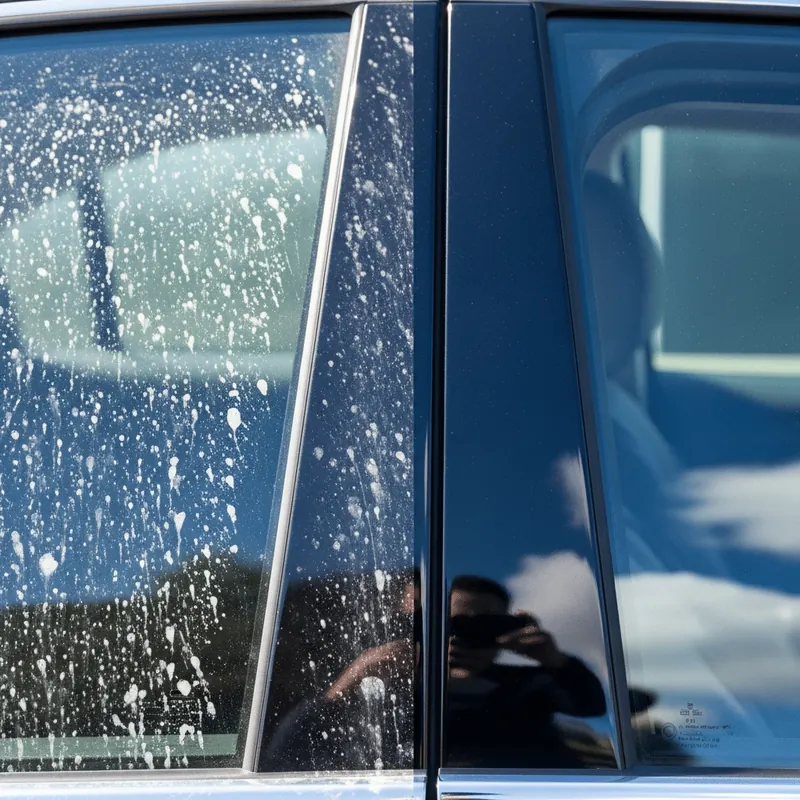
Clay can lift some bonded contamination on glass when used with suitable lubricant, but that does not make it the primary treatment for hard-water haze. Sud Factory’s path is Spotless X2 for glass water spots and etching, on the untinted side only. Keep Spotless X2 off paint.
Spotless X2 uses diamond micro-particles and polishing action. Damp is preferred. Work with a pad in overlapping directions, allowing 2–3 passes for harder stains. The optional medium-speed polisher with a white pad applies to Spotless X2 only, never Dissolve X2. Follow the product directions for cleanup.
A scratch, chip, or crack is not the same as a mineral spot. Have a glass professional assess physical damage. Spotless X2 can also remove headlight hazing, but that does not make it a full lens-repair or UV-restoration system.
Aftercare once the surface is clean
Check the remaining protection after decontamination. Clay can disturb wax or sealant, and a cleaner’s compatibility with a coating is not a promise that every protection layer stays unchanged. Follow the protection maker’s care instructions rather than assuming beading proves the panel is fully protected.
SFX1 is protection, not a remover for the rings already present. Apply it after cleaning according to its directions. It works on all exterior surfaces, lasts up to about 12 months and will not change a matte finish. That upper limit is not a promise that every surface will need no maintenance for a year.
Wash in shade, keep panels cool and dry before droplets bake. Move away from sprinklers when practical, including overnight overspray. Treat fresh deposits early rather than allowing repeated wet-dry cycles to build layers. Protection supports maintenance; it does not make hard water evaporate without leaving minerals.
See how to prevent water spots after washing for drying habits. If you are considering melamine instead of clay, read why a Magic Eraser is not a paint water-spot tool.
What to buy and what not to assume


Dissolve X2 costs $39.99 and has 850 reviews. Spotless X2 costs $39.99 and has 1,240 reviews. SFX1 has 540 reviews. Prices and review counts are the approved figures for November 6, 2026.
Buy for the surface you need to treat, not the number of tools you have tried. A paint-only job does not require the glass remover. If you need both, compare the current kit options and protection pricing on the product pages before ordering.
Shipping is free over $49.99 and $4.99 under that threshold. Check the shipping policy for the checkout terms. The 30-day money-back guarantee requires the customer to pay return shipping unless the item arrived damaged. Read the returns policy before ordering.
Sud Factory was founded in 2019 in Hawaii. See existing reviews and customer photos for examples of treated surfaces. Those photos do not establish the condition of your finish or guarantee the same result.
No Sud Factory clay product or preferred clay partner is offered here. If you need clay, use a fine-grade detailing bar with its proper lubricant and follow its instructions. For another paint-remover comparison, see Dissolve X2 vs Chemical Guys.
FAQ
Does a clay bar remove water spots?
Sometimes. Clay can remove surface mineral deposits, but cannot repair etched clear coat.
When does clay stop working?
Clay stops at the surface. If directed short remover passes leave an ingrained ring, assess etching rather than repeating clay.
What does clay actually remove?
Clay shears bonded surface contamination such as overspray, fallout, and some mineral deposits. It is not an acid or a paint polish.
Clay bar vs water spot remover, which do I need?
Use lubricated clay for bonded texture and a dedicated remover for mineral deposits. Neither is a universal first step after washing.
How do I use the wet test and baggie test?
Use water to compare wet and dry visibility, and a gentle baggie check on a clean, lubricated area for texture. Neither test proves etching.
How do I use Dissolve X2 after clay?
Test a spot, apply by hand, dwell about 30 seconds, and do not let it dry. Wipe, rinse, dry, and reassess before a second short pass.
What about clay on glass?
Clay can lift bonded contamination, but Spotless X2 is the Sud Factory path for glass water spots and etching. Use it on the untinted side only, never paint.
Does clay remove protection?
Clay can disturb wax or sealant. Check the finish and re-protect as directed. SFX1 works on all exterior surfaces and will not change matte.
Can clay damage paint?
Yes. Dry clay, trapped grit, or excess pressure can mar paint. Wash first, use proper lubricant, and discard a dropped bar.
What should I buy and what does it cost?
Dissolve X2 for paint and Spotless X2 for glass each cost $39.99 in the approved November 6, 2026 figures. No Sud Factory clay SKU is claimed.