
How to Get Water Spots Off a Black Car (Without Swirls)
Black paint shows mineral rings and the scratches left by rough attempts to remove them. Start with non-abrasive, hand-applied Dissolve X2 for deposits rather than polishing contamination that may not need abrasion at all.
Table of Contents
The short answer
- Wash cool panels in shade and rinse away grit.
- Dry with clean, plush microfiber or a suitable blower before beads bake.
- Test Dissolve X2 on paint, allow about 30 seconds and do not let it dry. Wipe damp, rinse and dry as directed.
- Inspect under good light and make another short pass if a ring remains.
- If the stain still will not come off on paint, it is ingrained in the clear coat. Stop chemical escalation and assess whether correction is needed.
- Use Spotless X2 separately for glass; protect clean surfaces afterward with SFX1.
This process avoids unnecessary abrasion, not every possible towel mark. Tool cleanliness, finish condition and pressure still matter. Test a small area before treating the whole hood.
Why black cars show water spots and swirls
White mineral rings contrast strongly against dark paint. Directional light also makes fine scratches and dull outlines easier to see. Angled LED light can reveal spots hidden head-on. Visibility alone does not establish a need for compound.
Sun and heat can speed evaporation, leaving less time to dry rinse water before minerals remain. Work in shade with a cool finish rather than treating a sun-heated black panel. Drying discipline is as important as choosing the correct bottle. If the same spots reappear after each wash, examine the water and timing before changing the removal method.
What causes swirls while fixing spots
Dirty towels, dry wiping over grit and repeated scrubbing can turn a spot-removal job into a correction job. Circular scrubbing can leave conspicuous patterns, but straight-line motion is not a magic shield against contamination. The first control is to remove grit and use clean, soft tools with light pressure.
| Avoid | Use instead | Reason |
|---|---|---|
| A towel that has picked up grit | A fresh clean plush microfiber face | Do not drag trapped particles across clear coat. |
| Dry rubbing a mineral ring | The directed chemical method on clean paint | More friction is not a diagnosis. |
| Repeated circular scrubbing | Light, controlled straight-line wipes | Keep pressure and residue controlled. |
| Compounding before cleaning | Wash, dissolve, inspect | Do not cut finish to remove a deposit that chemistry can lift. |
| 0000 steel wool on paint | No steel wool on paint | Household abrasives are not a paint-removal method. |
Fold towels so you can expose a clean face, and set a contaminated towel aside rather than hoping the next wipe cleans it. Keep glass-removal pads separate from paint pads. Rinsing the car does not clean a dirty towel.
Deposit vs etching on black paint
Wash and dry before assessing the mark. A mineral deposit is material on the finish; etching is damage into it. If the directed Dissolve X2 treatment removes the mark, you have removed contamination rather than polished away clear coat. If a dull ring remains after cleaning, it may be an underlying defect. For chalky or faded paint rather than isolated mineral rings, see the paint oxidation guide for a separate diagnosis.
Inspect the same patch from the same angle under consistent light. Take a reference photo in shade with a phone LED aimed across the panel, then compare it after the area is dry. Avoid diagnosing from a wet shine, which can hide outlines. Do not scrape the finish with a fingernail to find out whether the ring is raised.
Read water spots vs etching for the distinction. If the stain still will not lift on paint after the directed short passes, it is ingrained in the clear coat. More dwell, friction or repeated whole-panel treatment is not the next step.
Step-by-step without unnecessary abrasion
Wash and dry carefully
Use a clean mitt and a two-bucket method or an equivalent process that keeps grit away from the finish. Rinse thoroughly, then dry with clean, plush microfiber or a suitable blower. Do not start spot treatment while loose contamination is still on the paint. Work in sections small enough to manage without water drying around you.
Use Dissolve X2 on paint

Dissolve X2 is non-abrasive, hand-applied and requires no buffer. It is safe on clear coat and ceramic coatings when directed, and suitable for PPF and vinyl wraps with a test spot. Test wraps, PPF and finishes without clear coat rather than assuming they behave like a factory clear-coated hood.
Read the how-to-use instructions first. Put Dissolve X2 onto a microfiber applicator pad, not directly on the panel. Work a small test section with light pressure, allow about 30 seconds and do not let it dry. Wipe with a damp microfiber towel, rinse and dry. If a ring remains, make another short pass rather than increasing dwell.
Coating compatibility does not mean skin safety. Dissolve X2 contains buffered ammonium bifluoride (ABF). Its SDS uses the signal word “Danger” and states “Causes severe skin burns and eye damage.” Wear protective gloves and eye protection, work with ventilation, and follow the label and Dissolve X2 SDS PDF.
Keep Dissolve X2 off glass and glass mirrors. Plastic mirrors are OK, but verify the material rather than guessing. Test wraps, PPF and finishes without clear coat before proceeding. See the matte-paint, PPF, wrap and ABF safety guide for surface-specific limits.
Inspect and stop
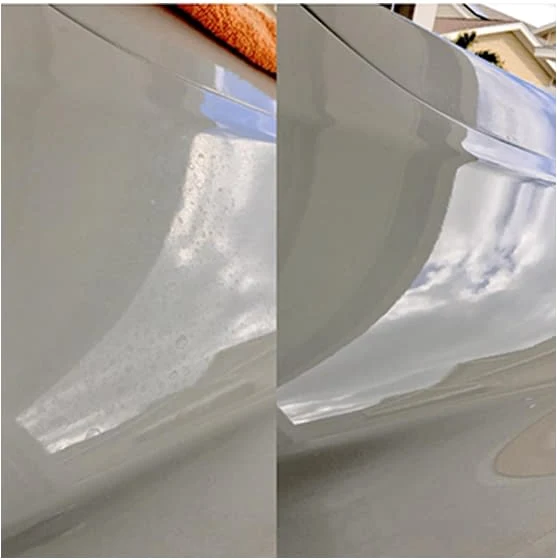
Compare the dry test area with the untreated section. If the deposit is gone, stop removal; do not polish automatically to finish the job. If a stain remains ingrained in the clear coat, seek a detailer’s assessment. Black paint can show holograms or other defects from poor polishing technique, so correction is not a casual extra step.
Tell the detailer which remover you used and how the test responded. Ask what protection correction will affect. This is a stop rule, not a full paint-correction course.
Keep the glass job separate

Use Spotless X2 for water spots on the windows, not for black paint. It is a polishing remover with diamond micro-particles, used with a little damp preferred and no sit or dwell. Harder stains may need 2–3 passes. Optional machine guidance is medium speed with a white pad; hand application does not require a buffer.
Use the untinted side only. Keep Spotless X2 off paint and natural stone, and note that it takes off factory easy-clean coating. Check any rain-repellent treatment’s care instructions first. Dissolve X2 is not the substitute for glass, even if the bottle is already in your hand.
What not to use on black paint
Do not use steel wool, including 0000 steel wool, on paint. Do not dry-wipe grit, use household abrasives or make an all-purpose cleaner the default mineral-removal treatment. A cleaner that removes general dirt is not automatically the right answer for bonded mineral rings.
Do not make vinegar the primary paint method or use household CLR around painted panels. Follow paint-compatible product directions without improvising stronger mixtures. Spotless X2 belongs on glass, not the hood.
Aftercare and prevention

SFX1 is protection, not a remover for the rings already present. Apply it after cleaning according to its directions. It works on all exterior surfaces, needs no buffer, lasts up to about 12 months and will not change a matte finish. That upper limit is not a promise that every car will need no maintenance for a year.
Wash in shade, keep panels cool and dry before droplets bake. Move away from sprinklers when practical, including overnight overspray. Treat fresh deposits early rather than allowing repeated wet-dry cycles to build layers. Protection supports maintenance; it does not make hard water evaporate without leaving minerals.
A deionized final rinse is optional, not required. Dry immediately, and check mirrors and trim for delayed drips before parking in sun.
Ceramic-coated black cars
The same chemical-first order applies to ceramic-coated black paint: Dissolve X2 is safe on ceramic coatings when directed. A coating can bead and still carry deposits. Follow installer guidance on fresh coatings and test first; there is no invented cure-day wait here.
Do not polish a coating away for a removable deposit. See the matte, PPF and wrap safety guide for surface limits.
What to buy
Dissolve X2 is $39.99 and has 850 reviews. Spotless X2 is $39.99 and has 1,240 reviews. Choose the paint remover for painted panels, the glass remover for windows, and SFX1 for protection after removal; SFX1 has 540 reviews.
The Ultimate Bundle includes Dissolve X2, Spotless X2 and SFX1 for $74.99. If only one surface is spotted, there is no need to buy a second remover for that job. Paint plus protection and glass plus protection are useful pairings, but compare the current bundle options on the product pages rather than assuming the same price for every pairing.
Shipping is free on orders over $49.99 and $4.99 under that threshold; expedited shipping is $19.99. Sud Factory ships to all 50 states, DC and military addresses. Read the shipping policy for the current terms. The 30-day money-back guarantee has a return-shipping condition: the customer pays unless the item arrived damaged. See the returns policy before ordering.
Sud Factory was founded in 2019 and is based in Hawaii. The existing site reports 500,000+ bottles shipped; that is a brand-level figure, not a result rate for this specific procedure. The reviews and existing customer photos help show the kinds of surfaces customers have treated, but a photo cannot establish the condition of your own finish.
For a surface-based overview, use the best water spot remover for cars guide. For formula and use differences, see Dissolve X2 vs Chemical Guys and Spotless X2 vs Bio-Clean. These are related comparisons, not a claim that this article ran a head-to-head laboratory test.
FAQ
Why are water spots more visible on black cars?
Light mineral rings contrast strongly against dark paint, and angled light also reveals fine scratches. Heat and evaporation can shorten the time available to dry rinse water, which is also how spots get a chance to sit and work into the clear coat.
How do I remove spots without putting swirls in the paint?
Wash grit away, use clean soft microfiber and test non-abrasive Dissolve X2 with light pressure. Avoid unnecessary polishing and dirty-towel scrubbing; this is a risk-reduction process, not a zero-swirl guarantee.
What is the least aggressive order of work?
Wash, use the directed Dissolve X2 test, inspect dry and make another short pass if needed. Reserve polishing for confirmed correction needs after a persistent ingrained mark is assessed.
Is Dissolve X2 safe on clear coat and ceramic-coated black paint?
Yes, when used as directed. Allow about 30 seconds without drying, wipe damp, rinse and dry, and follow installer guidance for a fresh ceramic coating. Still, don’t leave mineral spots sitting: they can sink into the clear coat and stop wiping off. Always test wraps and PPF first.
Which towel and wiping habits reduce marring?
Use clean plush microfiber, expose fresh towel faces and keep glass and paint applicators separate. Use light controlled straight-line wipes rather than repeated circular scrubbing; no motion makes grit safe.
How do I check deposits versus etching on dark paint?
Hard water spots left longer on paint are more likely to work into the clear coat — spots that sit can sink in and stop wiping off. Compare the same clean, dry test patch under consistent angled light. A mark that clears with the directed method was removable contamination; a persistent dull outline may be etching and should not be chased with harder rubbing.
What about water spots on the glass of a black car?
Use Spotless X2 on glass, with a little damp preferred and no dwell. Use the untinted side only and keep it off paint; harder stains can take 2–3 passes.
Should I use vinegar, steel wool or APC on black paint?
Hard water spots left longer on paint are more likely to work into the clear coat — spots that sit can sink in and stop wiping off. Do not use steel wool on paint or make vinegar or an all-purpose cleaner the default mineral-removal method. Start with a paint-compatible directed treatment instead of household abrasives or improvised mixtures.
How do I prevent spots after the next wash?
Wash cool panels in shade, dry before droplets bake and check delayed drips. Avoid sprinkler overspray and apply SFX1 after cleaning for protection lasting up to about 12 months.
What should I buy for a spotted black car?
Choose Dissolve X2 for paint at $39.99, and add Spotless X2 only if glass needs removal too. SFX1 is aftercare; the Ultimate Bundle includes all three for $74.99.